OR-5 Constituent Accountability Project · 2026 Primary

Bynum Is A Bummer.

We elected Rep. Janelle Bynum to fight — for immigrants, for the climate, for peace, for the Constitution. On five critical tests, she chose wrong. Oregon Democrats deserve to know.

■ Independent · Not affiliated with any candidate or campaign
Voted for Laken Riley Act
1,100 Oregonians arrested by ICE in 2025
68% of those arrested had no criminal conviction
$3.56M AIPAC-aligned money received

Rep. Janelle Bynum made history in 2024 as Oregon's first Black member of Congress. It was a big deal, and as her constituents we celebrated it.

This site exists because on five defining votes and moments since then, Rep. Bynum has made choices that many of those same constituents believe betray the values she was elected to represent.

Oregon's Democratic primary voters deserve the full picture before deciding whether she earns another term unchallenged.

Every claim here is sourced. Read it, verify it, share it.

Issue No. 1
01

She Voted for the Laken Riley Act — Twice — Then Wouldn't Answer on ICE

On January 7 and again on January 22, 2025, Rep. Bynum voted yes on the Laken Riley Act. The bill was signed into law. She was the only Oregon House Democrat to vote yes on final passage. The state's lone House Republican also voted yes.

What the Law Actually Does

The Laken Riley Act requires DHS to detain undocumented immigrants arrested for — not convicted of, merely arrested for — theft, shoplifting, or assault. Detention precedes any finding of guilt. States can sue the federal government if it fails to comply.

Source: GovTrack — House Vote #23, Jan. 22, 2025

All four of Bynum's Democratic Oregon colleagues — Bonamici, Dexter, Hoyle, and Salinas — voted no on final passage. Val Hoyle initially voted yes alongside Bynum but flipped before the final vote. Bynum did not.

Town Hall — Silverton, April 2025

"This is not fighting. This is not putting your body on the line. This is business as usual." — constituent who left the Silverton town hall early after pressing Bynum on the vote.

Source: OPB, April 23, 2025

Town Hall — Clackamas, January 2026

Nearly 400 constituents packed Camp Withycombe demanding answers on ICE enforcement. Sen. Wyden stated clear support for defunding ICE and redirecting funds to local law enforcement. Rep. Bynum, at the same event, did not give constituents an answer to the same question.

Source: KOIN 6, January 19, 2026

The Bottom Line

Every other Oregon House Democrat found the due process problems with this law disqualifying. Bynum didn't. Months later, when her constituents asked her directly about ICE funding, she declined to answer while her colleague Sen. Wyden took a clear public position at the exact same event.

Bynum's camp argues OR-5 is a swing district. That's a real argument. The question for primary voters is whether ceding ground on constitutional due process is the right trade to make.
Issue No. 2
02

She Voted Against California's EV Mandate — With Climate-Skeptic Republicans

In May 2025, Rep. Bynum was among just 35 House Democrats who crossed the aisle to vote with Republicans to revoke the federal waiver that allowed California to phase out gas-powered cars by 2035.

Why This Hits Oregon Directly

Oregon adopted California's Advanced Clean Cars II standards under Section 177 of the federal Clean Air Act — the same waiver Bynum voted to revoke. Because of that, the vote didn't just affect California. It stripped Oregon of the ability to enforce the stricter vehicle emissions standards it had adopted, undermining the clean energy framework Oregon had tied its 2035 zero-emission vehicle goals to.

The Bottom Line

In the same weeks she was standing at town halls promising to fight Trump's environmental rollbacks, Rep. Bynum voted alongside climate-denying Republicans to gut one of the most important clean energy standards in the country. The contradiction is stark.

Issue No. 3
03

On Gaza, She Signed With the Pro-Israel Establishment While $3.56M in AIPAC Money Followed Her In

During her 2024 campaign, Bynum called for "an immediate ceasefire" — while stopping well short of calling for any conditions on U.S. military aid to Israel. Once in Congress, her positions tracked closely with the pro-Israel Democratic establishment.

Campaign Words vs. Congressional Action

"I believe in the safety and security of our democratic ally Israel. I also believe we need to protect innocent Gazans and humanitarian workers. There must be a ceasefire immediately." — Bynum, Oct. 2024

Source: OPB Candidate Q&A, Oct. 18, 2024

In May 2025, Bynum was one of 41 House Democrats who signed a Democratic Majority for Israel (DMFI) statement focused on hostages and "post-Hamas Gaza" with no mention of ceasefire and no call to limit weapons transfers. Oregon's Indivisible groups pushed her to co-sponsor HR 3565, which would limit military aid to Israel. She did not.

In January 2026, Bynum voted yes on a spending bill that included $3.3 billion in military grants for Israel — disbursable within 30 days, with no conditions on how the weapons are used. The funds were structured as grants, not loans. No human rights review. No pause mechanism. No accountability.

Source: H.R. 7006, 119th Congress — Full Text

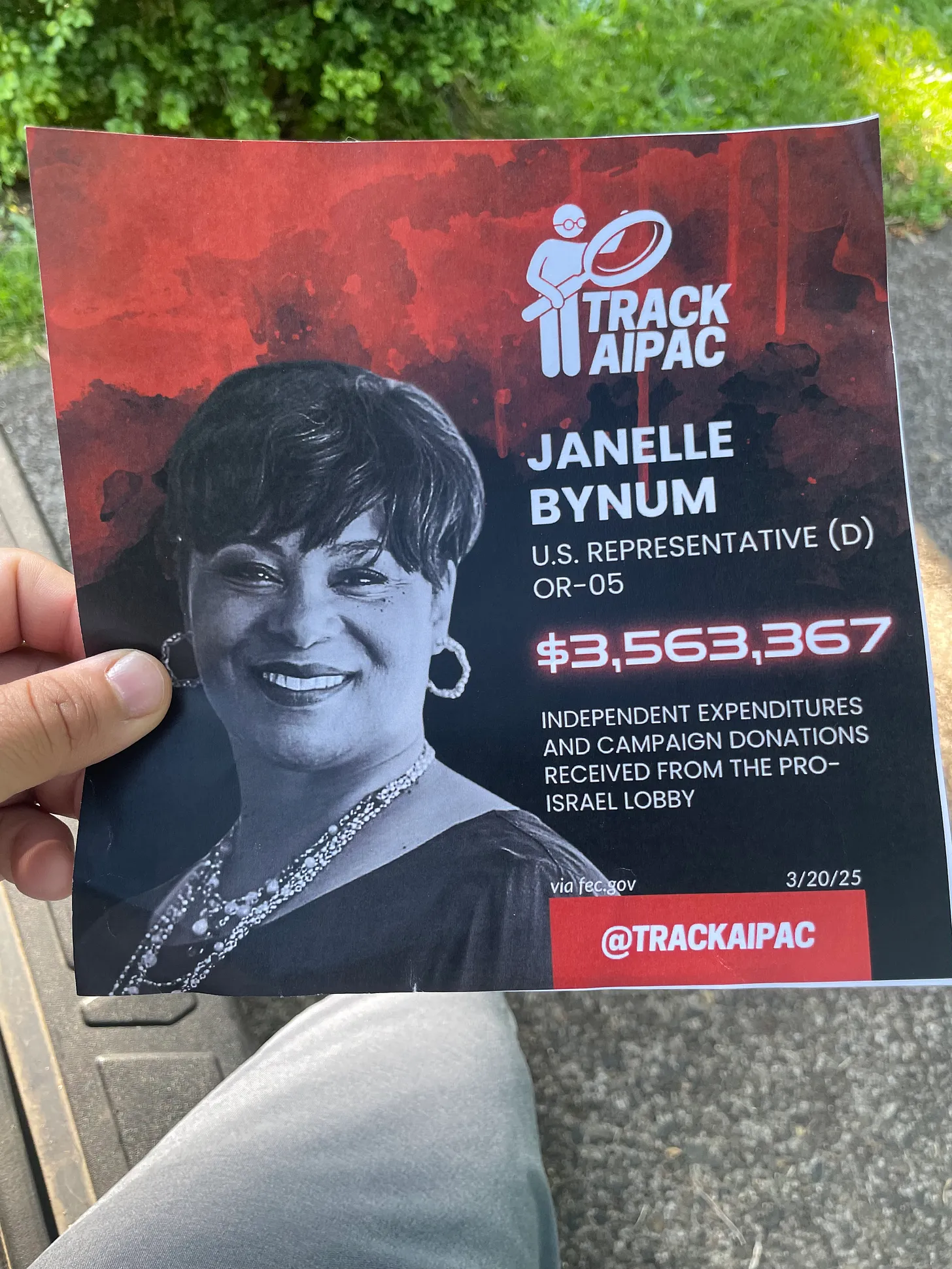
TrackAIPAC document showing $3,563,367 in pro-Israel lobby spending on Janelle Bynum, sourced from FEC data as of 3/20/25

■ Primary source: TrackAIPAC, via fec.gov — dated 3/20/25

$3,563,367

In independent expenditures and campaign donations from the pro-Israel lobby — more than the entire rest of Oregon's congressional delegation combined, and largely through dark-money channels. This includes spending in her 2024 primary to defeat progressive challenger Jamie McLeod-Skinner.

The Bottom Line

Bynum has condemned Netanyahu and expressed concern for Palestinian civilians. But she hasn't called for conditioning military transfers, signed onto weapons-limit legislation, or broken from DMFI's talking points. The $3.56M in AIPAC-aligned campaign support provides essential context for whose priorities are shaping her positions.

A ceasefire framework between Israel and Hamas took effect in October 2025. This reflects her record during the period when congressional action on military aid was most consequential.

Issue No. 4
04

She Was Silent When It Could Have Mattered. Now We're at War.

In June 2025, as Israel struck Iran and the Trump administration escalated toward direct U.S. military involvement, a bipartisan War Powers Resolution emerged in Congress — co-authored by Rep. Ro Khanna (D-CA) and Rep. Thomas Massie (R-KY). It required a congressional vote before any U.S. military involvement in hostilities with Iran. Oregon's Sen. Jeff Merkley and Reps. Val Hoyle, Suzanne Bonamici, and Maxine Dexter publicly backed it.

Rep. Bynum did not sign on.

What Congress Already Knew

Trump's own Director of National Intelligence, Tulsi Gabbard, testified under oath before the Senate Intelligence Committee on March 25, 2025 — three months before U.S. strikes began — that the intelligence community "continues to assess that Iran is not building a nuclear weapon and Supreme Leader Khamenei has not authorized the nuclear weapons program he suspended in 2003." That assessment did not stop the war. It just made the case for a congressional vote even clearer.

Source: Office of the DNI, March 25, 2025 · PBS NewsHour, June 2025

Constituents Calling Her Office Got Nothing

During the week of June 20, 2025, constituents calling Bynum's office about the Iran crisis were told to subscribe to her newsletter. Staff couldn't provide any position on the War Powers Resolution or U.S. military involvement.

Source: KalikoVision, June 2025

Then It Got Worse

On June 22, 2025, the U.S. military struck three Iranian nuclear facilities — without a congressional vote. Iran retaliated by striking a U.S. base in Qatar. A ceasefire followed two days later. Trump declared the strikes had "completely and totally obliterated" Iran's nuclear program.

Then, on February 28, 2026, Trump launched a second, larger military campaign against Iran — again without congressional authorization. Iranian Supreme Leader Ayatollah Ali Khamenei was killed. Iran retaliated across the region, striking U.S. military bases in Bahrain, Qatar, Kuwait, Jordan, and Saudi Arabia. American service members have died. A girls' elementary school in southern Iran was struck, killing an estimated 175 people — nearly all of them children.

Source: Operation Midnight Hammer, June 2025 · NPR, February 28, 2026 · CNBC, March 4, 2026

What Bynum Said vs. What She Did

After the February 2026 strikes, Bynum issued a statement calling them "a clear violation of his Constitutional authority" and said Congress "must vote on a War Powers resolution immediately." She voted yes on the House War Powers resolution on March 5, 2026. That resolution failed 212–219.

The same bipartisan War Powers resolution — introduced by the same Massie-Khanna duo — was available to her in June 2025. She didn't co-sponsor it. She didn't publicly back it. It failed by 7 votes.

Source: KATU, February 28, 2026 · Axios, March 5, 2026

The Bottom Line

The Iraq War cost $3 trillion and 4,400 American lives after Congress failed to assert its constitutional war-making authority. In June 2025, the War Powers Resolution that could have forced a vote on Iran failed by 7 votes. Bynum wasn't a co-sponsor. She called the strikes "illegal" after the fact — and then watched the same constitutional crisis play out again nine months later, bigger and bloodier. She couldn't get there until it was too late.

Supporting this resolution required no position on Iran's nuclear program, no stance on Israel, no complex geopolitical judgment — only agreement that the Constitution, not the president alone, decides when America goes to war.

Issue No. 5
05

She Helped Pass Trump's Crypto Bill — While Oregon's Own Senator Called It Corruption

On July 17, 2025, Rep. Bynum was one of 102 House Democrats who voted yes on the GENIUS Act — the first major federal cryptocurrency legislation in U.S. history, establishing a regulatory framework for stablecoins. The bill passed 308–122 and was signed by President Trump the next day.

Why Democrats Opposed It

The Trump family's company, World Liberty Financial, had issued its own stablecoin — USD1 — which stood to benefit directly from the new regulatory framework. Critics argued the bill gave the president a financial stake in its outcome while blocking amendments that would have barred elected officials from personally profiting off crypto ventures during their time in office.

Source: NPR, July 17, 2025

Oregon's Senator Drew a Clear Line

Sen. Jeff Merkley — Oregon's other voice in Congress — voted against the GENIUS Act and denounced it from the Senate floor, arguing that guardrails preventing officials from personally profiting from stablecoin ventures were "completely, totally absent" and that the bill amounted to "rubberstamping Trump's crypto corruption." Bynum voted the opposite way.

Source: CNBC, June 17, 2025 · Common Dreams, July 17, 2025

$250M

The crypto industry spent over $250 million in the 2024 election cycle to elect what it called "the most pro-crypto Congress in U.S. history" — and warned it would target lawmakers who stood in the industry's way.

The Bottom Line

This wasn't a close call. The president's family had a direct financial stake in this bill. Oregon's senator said so clearly and voted no. Bynum voted yes — helping deliver Trump one of his biggest legislative wins outside the Big Beautiful Bill, while consumer advocates and progressive Democrats warned the bill lacked basic guardrails against corruption.

Supporters argue the GENIUS Act creates needed regulatory clarity for an industry that affects millions of consumers. The question is whether passing it without anti-corruption amendments — and against the explicit position of Oregon's own senator — was the right call.

Take Action

What Can I Do?

After a disastrous first term in Congress, OR-5 voters are left with very little options by way of accountability. Only one person has filed to run against Rep. Bynum and there are no public forums planned for the primary election. As her constituents we are unhappy with her lack of leadership in this critical moment in American history and must make our voices heard.

01

Leave It Blank

When you write in a protest vote in Oregon, it doesn't just go unnoticed — it goes uncounted entirely. Under Oregon law, individual write-in names are never tallied unless the total write-in count surpasses the vote total of the filed candidate — a threshold that is virtually impossible to meet in any contested race. Your name, your message, your protest: legally discarded. But a blank line leaves a permanent mark. Undervotes are recorded in certified election results, and when thousands of voters complete every other race on their ballot but skip one, that gap becomes a documented, statistically measurable signal that analysts, journalists, and party officials cannot ignore. A coordinated "Leave It Blank" effort doesn't just register dissatisfaction — it proves it, in official data, permanently. You showed up. You voted. You just refused to say yes.

02

Vote for Zeva

Zeva Rosenbaum isn't just a protest vote — she's a proof of concept. Running without corporate PAC money, refusing AIPAC funding, and centering working-class values in a district where most politicians triangulate toward the middle, Zeva represents what a people-first campaign actually looks like. Even if she doesn't win, every vote she earns is a data point — a documented, certified signal that a meaningful portion of OR-5 wants something different. Primaries are how parties learn what their voters actually believe. Voting for Zeva is how you make sure that lesson gets recorded.

Spread the Word

Know an OR-5 Voter?
Send This Their Way.

This site exists to inform — not to tell anyone what to think. If you found it useful, the most powerful thing you can do right now is share it with someone who votes in Oregon's 5th District.

✓ Copied